In This Article
When a Tequesta or Jupiter Island homeowner calls about a roof leak, the cause is flashing failure more often than any other single factor — more often than tile damage, more often than underlayment failure, and more often than any drainage deficiency. Flashing — the metal or membrane material installed at every roof transition point, penetration, and termination — is the component that bridges the gaps that tile and membrane cannot cover on their own. It is also the component most directly exposed to South Florida’s salt air, thermal cycling, and wind-driven rain. Understanding why flashing fails, how each failure type presents, and what material choices provide the longest service life in the coastal Palm Beach County environment allows homeowners to maintain the one roofing component that causes the majority of their leak exposure.
Why Flashing Is the Primary Leak Liability on South Florida Roofs
The roofing system on any residential structure is not a single continuous surface — it is a field of primary roofing material interrupted by dozens of transition points where the roof plane meets a vertical surface, changes slope, terminates at an edge, or is penetrated by a pipe, vent, skylight, or chimney. At every one of these interruptions, the primary roofing material cannot provide continuous waterproofing — the geometric transition requires a separate component designed specifically for that transition. That component is flashing.
The vulnerability of flashing relative to the primary roofing material is a function of its position and configuration. Flashing is typically installed at locations where two building planes meet — wall-to-roof transitions, valley intersections, parapet terminations — and these locations concentrate both water flow and thermal movement stress. Water flowing across a roof surface converges at valleys and accumulates at wall-to-roof transitions; the flashing at these locations handles more water per unit area than the field of the roof. Temperature changes that cause the entire roof assembly to expand and contract concentrate their movement stress at the fixed termination points where flashing is attached to both the roof structure and the adjacent building element.
“Flashing failures cause more South Florida roof leaks than tile failures, underlayment failures, and drainage failures combined. The component costs pennies per linear foot. The interior damage it causes when it fails costs tens of thousands.”
The Four Most Common Flashing Failure Types
Flashing failures in South Florida residential roofing present in four primary patterns, each with a distinct cause, a distinct location on the roof, and a distinct remediation approach. Recognizing which failure type is present determines the correct repair strategy — a misdiagnosed flashing failure that is repaired with the wrong approach will recur, sometimes more quickly than the original failure.
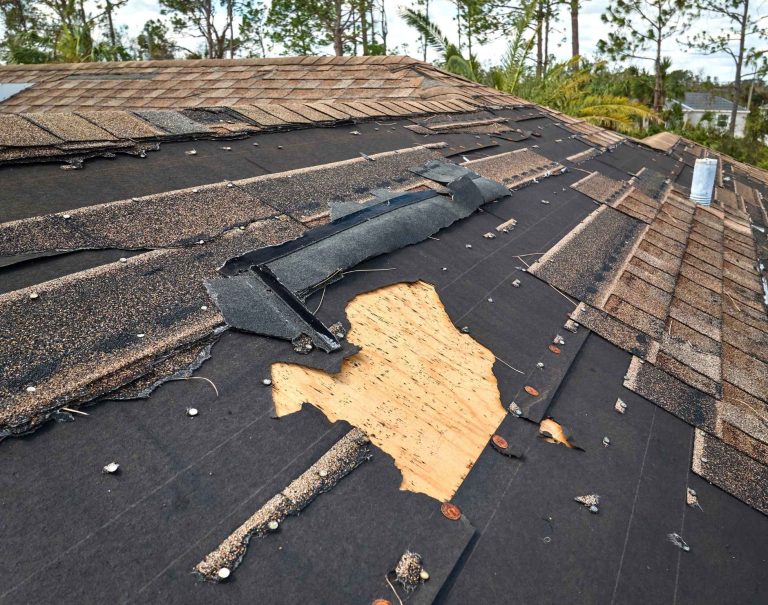
Corrosion perforation is the most common failure type in pre-2000 South Florida construction. Galvanized steel flashing — the standard flashing material in that era — corrodes from both surfaces in the salt air environment. The exterior surface corrodes from direct salt aerosol and moisture exposure; the concealed interior surface corrodes from moisture that migrates under the flashing from the underlayment zone. When corrosion perforates the metal, it creates a pinhole or crack that allows water infiltration directly through the flashing material itself. Corrosion perforation is typically not visible during an exterior inspection — the perforation is concealed under tile or sealant — and is most commonly identified when water staining appears on interior ceilings beneath flashing locations.
Corrosion perforation — most common in pre-2000 galvanized flashing Invisible from exterior, confirmed by interior ceiling staining under flashing locations. The repair is flashing replacement — not sealant application over corroded metal.
Sealant failure — requires removal and reapplication, not layering New sealant over failed sealant is a temporary fix that fails faster than a properly prepared joint. Remove all failed sealant, clean the substrate, then apply new sealant to bare material.
Fastener backout — caused by thermal cycling over 15–20 years Gaps that open at fastener locations under wind-driven rain are often misdiagnosed as underlayment failure. Probe flashing at fastener locations during inspection to identify movement.
Valley flashing degradation — produces the highest-volume leak events Valley locations handle the highest water volume on the roof. Degraded valley flashing produces rapid, large-volume water intrusion during heavy rain events — typically the most dramatic leak presentation.
Flashing Material Selection for Coastal Florida
The choice of flashing material for a Palm Beach County roofing project is one of the highest-leverage decisions in the entire specification — a decision that determines service life at a cost differential that is small relative to the total project budget but significant relative to the potential leak exposure over the system’s life. The coastal salt air environment that accelerates galvanized steel corrosion makes material selection more consequential here than in inland markets.
Aluminum is the baseline specification for coastal Florida flashing applications. Aluminum does not rust — it forms a stable oxide layer on its surface that actually protects the underlying metal from further oxidation, unlike galvanized steel where zinc coating failure exposes the steel substrate to corrosion. Minimum thickness for residential aluminum flashing in the HVHZ is 0.027 inches for standard applications and 0.032 inches for high-exposure locations including valleys, eaves, and wall-to-roof transitions. The thicker gauge provides both additional corrosion reserve — more aluminum to be consumed before perforation — and greater resistance to the physical deformation that can create water dams under heavy rain conditions.
“The upgrade from 0.027-inch galvanized to 0.032-inch aluminum flashing adds approximately $800 to a typical re-roofing project. The interior damage from a single flashing failure typically costs $15,000–$30,000 to remediate. The math favors the upgrade.”
Flashing Inspection Timing and Replacement Strategy
The optimal timing for flashing inspection on a Palm Beach County home is the annual pre-hurricane season roof assessment — a spring inspection conducted before the June 1 hurricane season onset that evaluates flashing condition while there is still time to complete repairs before the heaviest rainfall months. This inspection cadence ensures that flashing failures are identified and remediated before the storm season stress tests the roof system, rather than being discovered through a leak event during a heavy rain or wind event.
The inspection scope should include all wall-to-roof step flashings, valley flashings, penetration flashings at all pipes and vents, eave drip edge and , and any parapet or flat-to-sloped transition flashings. Each location should be evaluated for corrosion condition, sealant integrity, mechanical fastener security, and the presence of any gaps or deformations that could allow water entry under wind-driven rain conditions. Flashing that is approaching end of life — showing significant corrosion, cracked sealant, or fastener backout — should be noted for replacement rather than repair, because piecemeal repair of end-of-life flashing generates recurring call-back costs that exceed the one-time replacement cost over a short time horizon.
Annual pre-hurricane season inspection is the correct maintenance cadence Spring inspection before June 1 identifies flashing failures while there is still time to complete roof repairs before hurricane season. Discovering failures during a storm event is always more expensive than proactive identification.
Replace all flashing during re-roofing — never selectively retain The labor cost of tile access is already incurred. Retaining original flashing to reduce bid price creates call-back liability within the new system’s first 5 years. Require complete flashing replacement in your specification.
Specify 0.032-inch aluminum minimum for coastal applications The upgrade from standard to heavy-gauge aluminum adds minimal project cost but meaningfully extends flashing service life in the salt air environment. Specify the gauge in your roofing specification — not just “aluminum flashing.”
Proactive replacement on aging galvanized is cheaper than reactive damage repair At the 15–20-year mark, galvanized flashing replacement costs $3,500–$7,500. The interior damage from a single failure it causes costs $15,000–$30,000. Proactive replacement has a compelling economic case.