In This Article
One material designation on your roofing specification can reduce your annual homeowner’s insurance premium by thousands of dollars — and most Palm Beach County homeowners have never heard of it. Impact-resistant roofing isn’t marketing language. It’s a specific, testable, code-defined performance standard that Florida insurers recognize and reward with meaningful premium discounts. For Tequesta and Jupiter homeowners navigating both hurricane risk and escalating insurance costs, understanding this standard is no longer optional.
What “Impact-Resistant” Actually Means
The term “impact-resistant” in Florida roofing has a precise technical definition governed by two test protocols: UL 2218 for metal and shingle products, and FM 4473 for membrane and tile systems. Both tests simulate the impact of hailstones at terminal velocity — but in a Florida coastal context, the relevant threat isn’t hail. It’s wind borne debris: roof tiles from neighboring properties, tree branches, and construction materials accelerated to 130+ mph during a hurricane event.
UL 2218 classifies products on a four-tier scale. Class 1 is the minimum. Class 4 is the highest rating achievable and the threshold that triggers Florida insurance discounts. A Class 4 designation means the material withstood the impact of a 2-inch steel ball dropped from 20 feet twice at the same point without fracturing or allowing penetration — a simulation of large hail or significant wind borne debris impact.
“A Class 4 impact rating isn’t just a product specification — it’s the single roofing decision most likely to generate a measurable financial return for a Tequesta homeowner within the first three years.”
Materials That Meet the Standard
Not every roofing material can achieve Class 4 impact resistance, and within material categories, not every product qualifies. The distinction is at the product level, not the material category — which means specifying “metal roofing” or “tile roofing” is not sufficient. The specific product must carry a current UL 2218 Class 4 or FM 4473 listing.
For South Florida’s luxury residential market, the qualifying materials we specify at Luxe Roofing fall into three primary categories. Standing seam aluminum and steel systems from manufacturers including Englert, Metal Sales, and ATAS consistently achieve Class 4 ratings and are the most straightforward impact-resistant specification for coastal properties. Impact-resistant concrete tile from manufacturers including Boral and Eagle Roofing Products carries FM 4473 ratings and qualifies for the full Florida wind mitigation discount. Modified bitumen and PVC membrane flat roofing systems carrying FM 4473 listings also qualify — relevant for the significant proportion of Jupiter and Tequesta homes with flat or low-slope roof sections.
Standing seam metal The most consistently Class 4-rated roofing system available. Aluminum preferred for coastal salt exposure, minimum 24-gauge steel acceptable inland.
Impact-rated concrete tile FM 4473-listed products from Boral, Eagle, and Westlake Royal qualify. Verify the specific SKU — not just the brand name.
PVC and TPO membranes FM 4473-listed flat roofing membranes qualify for wind mitigation credit on low-slope sections — verify the listing before specification.
Impact-rated shingles Class 4 asphalt shingles exist but are not our recommendation for coastal Palm Beach County due to UV and salt degradation concerns.
The Insurance Premium Connection
Florida’s insurance crisis has hit Palm Beach County homeowners harder than almost anywhere else in the state. Annual premiums for coastal properties in Tequesta and Jupiter that were $8,000–$12,000 five years ago are now routinely $18,000–$28,000 — and in some cases significantly higher for larger estate properties. In this environment, the wind mitigation discount available through impact-resistant roofing is not a minor line item. It is a substantial and recurring financial benefit.
Florida statute requires insurers to offer discounts for wind mitigation features verified through the OIR-B1-1802 inspection form. A roof covering discount for qualifying impact-resistant materials — combined with the roof deck attachment and roof-to-wall connection credits available on well-built homes — can reduce the wind portion of a premium by 30–45%. On a $24,000 annual premium, that represents $7,200–$10,800 in annual savings.
“On a $24,000 annual premium, the wind mitigation discount from a Class 4 roof can generate $7,000–$10,000 in annual savings — a payback period measured in months, not years.”
Installation Standards That Validate the Rating
A Class 4-rated product installed incorrectly does not deliver a Class 4 result — and Florida’s wind mitigation inspection process is designed to catch exactly this gap. The OIR-B1-1802 form evaluates not just the roofing material but the installation method, fastening pattern, and underlayment system. A product-level rating means nothing if the installation doesn’t meet the manufacturer’s listed installation requirements.
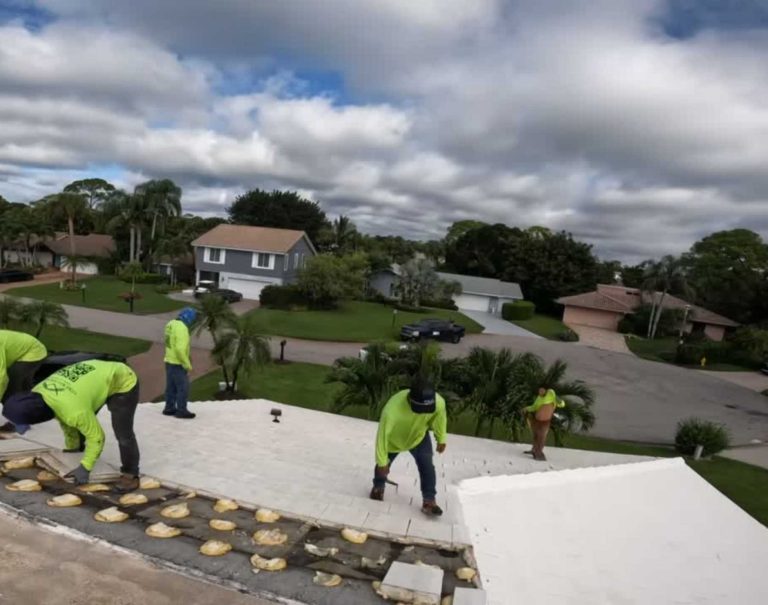
For tile systems, foam adhesive installation is required to achieve the full FM 4473 wind uplift rating — two-point nailing alone does not satisfy the listing requirements for coastal Palm Beach County wind zones. For metal systems, the seam profile, clip spacing, and panel engagement depth all affect whether the installed system performs to its rated uplift resistance. For membrane systems, fastener density at field and perimeter zones is the critical variable.
Request the product’s UL or FM listing certificate Not the marketing sheet — the actual test listing document confirms the specific installation requirements that must be followed.
Foam-set tile installation required for full rating Two-point nailing alone does not achieve the FM 4473 uplift rating in Palm Beach County coastal wind zones.
Schedule wind mitigation inspection immediately post-installation Don’t wait for renewal. Submit the updated OIR-B1-1802 to your insurer as soon as the inspection is complete.
Verify your contractor knows OIR-B1-1802 Any contractor who doesn’t know what OIR-B1-1802 is should not be installing impact-rated roofing systems on your property.