In This Article
Most Tequesta homeowners assume that a roof replacement should be scheduled in the spring — before hurricane season — and that January and February are too early to think seriously about a re-roofing project. This assumption costs them money, reduces their access to the best installation crews, and results in a project executed under pre-season urgency rather than dry-season efficiency. January and February are objectively the best months of the year to execute a re-roofing project in Tequesta — for reasons that span installation quality, contractor availability, permit timelines, material pricing, and the strategic advantage of completing the project with months of clear weather ahead and a full hurricane season of protection from day one of the new system’s life.
Why Winter Is Tequesta’s Best Re-Roofing Window — The Full Case
The case for winter re-roofing in Tequesta rests on five independent advantages that converge in January and February to create the most favorable project conditions of the calendar year. Each advantage is meaningful on its own — together they produce a project quality, scheduling, and pricing outcome that April and May re-roofing projects cannot match regardless of how well they are managed.
The first advantage is weather stability. January and February in Tequesta deliver the driest, most consistent weather conditions of the year — average rainfall of 2 to 3 inches per month versus the 6 to 9 inches of the spring months and the 7 to 10 inches of peak summer. Roofing installation requires dry deck conditions for underlayment adhesion and tile foam adhesive cure. A winter project in Tequesta is almost never interrupted by rain-related installation delays — a single afternoon thunderstorm can shut down a spring or summer project for a full day and compress the installation schedule in ways that affect crew efficiency and material sequencing. The weather stability of January and February is not incidental — it is a structural installation quality advantage that translates directly into better adhesive cure, better underlayment adhesion, and a more precisely sequenced installation than wet-season or shoulder-season projects achieve.
The second advantage is crew quality and attention. Luxe Builder Group’s most experienced crews — the senior tile setters and flashing specialists whose work quality defines the Luxe specification standard — are fully available in January and February. The pre-season period compresses crew scheduling in ways that force difficult choices about crew composition and project sequencing. In the winter window, every project receives the full attention of the appropriate crew at the appropriate pace — no compression, no substitution, no parallel scheduling that divides experienced crew members across multiple projects simultaneously. The project that begins in January and is installed in February is the project that receives Luxe Builder Group’s best uncompressed crew deployment of the year.
The third advantage is permit timeline predictability. Palm Beach County’s building permit office processes HVHZ roofing permits at its most predictable pace in January and February — the volume of applications is at its annual low, reviewer attention is not divided across a surge of pre-season submittals, and the typical 2 to 4 week approval timeline is most reliably achieved during these months. A permit submitted in January is reviewed and approved before the February installation window opens. A permit submitted in April is reviewed in competition with every other homeowner’s pre-season urgency and frequently takes 4 to 6 weeks rather than 2 to 4 — compressing the installation schedule toward the season open.
The fourth advantage is the strategic positioning the winter completion creates. A re-roofing project completed in February is a project that has been permitted, installed, inspected, and documented before the April pre-season window opens. The homeowner who completes a re-roof in February enters the April inspection window with a new system — the April inspection becomes a confirmatory check of the new installation rather than a discovery inspection that must then urgently address what it finds. Every subsequent hurricane season — for 25 to 50 years depending on the system specified — begins with a fully documented, verified installation rather than an aging one approaching its replacement cycle. The winter project is not just better executed — it is better positioned for everything that follows.
Installation Quality Advantages in Tequesta’s Winter Conditions
The installation quality advantages of winter conditions in Tequesta are specific and technical — not general observations about “nice weather” but precise material performance benefits that the January and February climate delivers compared to every other month of the year.
Self-adhering secondary water barrier — the Carlisle WIP 300HT or equivalent SWB product that is the foundation of the Luxe underlayment specification — performs optimally in the temperature range of 50°F to 90°F. January and February in Tequesta deliver average daytime temperatures in the low to mid 70s — precisely within the optimal adhesion range for self-adhering membrane products. Summer installations face afternoon deck surface temperatures of 140°F to 160°F that can cause the adhesive compound to flow rather than bond uniformly, requiring careful sequencing and shading procedures that add complexity to the installation. Winter installations simply do not face this challenge — the adhesive performs as designed, uniformly, across the full deck area, without the thermal management procedures that summer installations require.
Tile foam adhesive — the two-component polyurethane foam used for HVHZ corner and edge zone tile attachment — has temperature-sensitive cure characteristics that favor winter installation conditions. Foam adhesive applied in Tequesta’s winter temperature range achieves its design cure strength and cell structure within the manufacturer’s specified time window. Foam applied in summer’s high-heat conditions cures more rapidly and with a higher cell density than the design specification anticipates — sometimes producing a slightly more brittle bond than optimal winter-temperature cure. This is a subtle distinction but for a material whose primary function is HVHZ wind uplift resistance, the optimum cure conditions of winter are preferable to the accelerated cure conditions of summer.
Tile mortar at hip and ridge cap locations — used for aesthetic finish and water exclusion at the highest wind-exposure locations on the roof — achieves its best cure strength and adhesion in winter’s moderate humidity and temperature conditions. Mortar applied in summer’s heat and humidity cures rapidly at the surface while the interior remains uncured longer — creating a cure differential that can produce surface checking in the mortar bed over subsequent thermal cycles. Winter mortar application in Tequesta’s cooler, lower-humidity conditions cures uniformly throughout the bed depth, producing the dense, well-bonded mortar joint that performs best under the repeated thermal cycling that Tequesta’s coastal environment imposes.
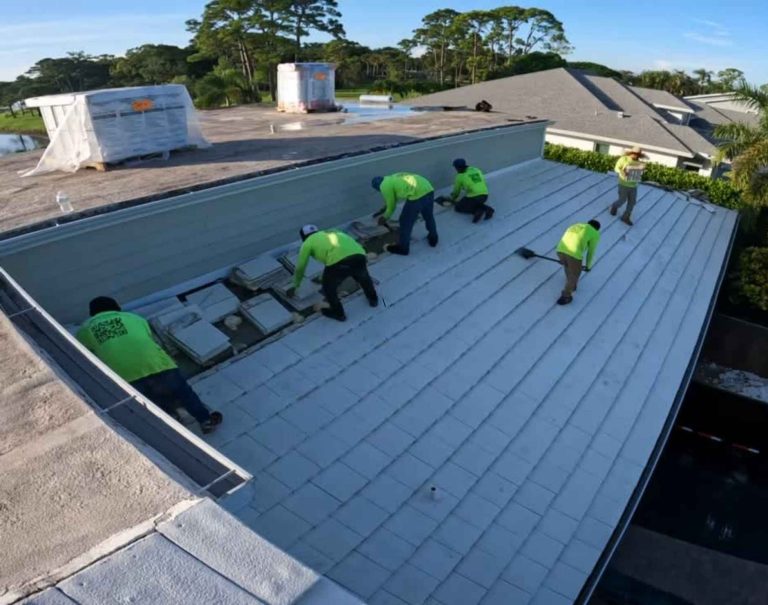
The rain interruption dimension is perhaps the most practically significant winter installation quality advantage. A tile re-roofing project on a Tequesta luxury home typically requires 5 to 10 business days of installation time — during which the property has sections of exposed deck, installed underlayment, and partially installed tile at various stages of completion. In the summer and spring months, a single afternoon thunderstorm interrupts this sequence, forces tarping procedures, and may require re-staging of materials that were positioned for the following morning’s installation. In January and February, these interruptions essentially do not occur. The installation sequence proceeds at its designed pace, every day, until completion — producing a project executed at the crew’s optimal efficiency without the accumulated inefficiency of weather interruptions.
SWB adhesion: 70s daytime temperature is optimal — no thermal flow risk that summer creates Self-adhering underlayment bonds uniformly across the full deck in winter’s moderate temperature range. Summer deck surface temperatures of 140–160°F require thermal management procedures that winter installation simply does not need.
Tile foam adhesive: optimal cure strength and cell structure in winter temperature range Foam adhesive cures to design specification in winter’s moderate temperatures. Summer’s heat accelerates cure to a higher cell density than design specification — a subtle but measurable distinction for the material whose function is HVHZ wind uplift resistance.
Hip and ridge mortar: uniform through-depth cure in winter — no surface checking risk Winter’s cooler, lower-humidity conditions produce uniform mortar cure throughout the bed depth. Summer’s heat creates surface-fast cure with a slower interior — the differential that leads to surface checking over subsequent thermal cycling.
Zero rain interruptions: installation sequence proceeds at designed pace every day January and February afternoon thunderstorms are rare in Tequesta. The 5 to 10 business day installation sequence completes at designed efficiency — no tarping procedures, no material restaging, no accumulated inefficiency from weather interruptions.
Scheduling and Pricing Advantages of the Winter Window
Beyond the installation quality advantages, the winter window delivers measurable scheduling and pricing benefits that compound the case for January and February project execution over April and May alternatives.
Contractor scheduling flexibility is at its annual maximum in January and February. Luxe Builder Group’s project calendar in these months allows homeowners to select their preferred installation start date within a 2 to 3 week window — a flexibility that the pre-season period eliminates entirely. By March, the installation schedule is filling toward capacity. By April, installation start dates are dictated by the schedule rather than chosen by the homeowner. By May, the homeowner who has not already begun a project is competing for the last available slots in a fully booked market. The January homeowner chooses their start date. The April homeowner accepts whatever start date remains available.
Material pricing in the winter window reflects the calmer supply chain conditions of the off-season. Tile and metal roofing material pricing in the Tequesta market does not spike dramatically in spring — but availability of specialty profiles and preferred colors is meaningfully better in winter than in April and May, when multiple projects drawing from the same regional material supply chain create competition for preferred specifications. A homeowner who specifies a particular terracotta profile or Kynar metal color in January has the full regional inventory available to source from. The same specification in April may face a 2 to 4 week lead time extension because preferred profiles are in high demand from the spring project wave — an extension that compresses the installation timeline toward the season open.
The permit timeline advantage is the most reliably quantifiable scheduling benefit of the winter window. Palm Beach County HVHZ permit approvals in January average 2 to 3 weeks from submission — the most predictable and shortest typical approval window of the calendar year. The same submission in April takes 3 to 5 weeks on average as the pre-season surge compresses the building department’s review capacity. For a Tequesta homeowner who needs to coordinate permit approval timing with their installation crew schedule and material delivery, the winter permit timeline’s predictability is a project management advantage that reduces the scheduling uncertainty that April and May project execution routinely encounters.
The cumulative scheduling advantage produces a project that completes in February with the following outcomes: a permit closeout certificate received in late February, a wind mitigation inspection conducted in early March, and a wind mitigation report delivered to the homeowner and filed with their insurer in mid-March — three months before the hurricane season opens. The insurance benefit materializes immediately at the next renewal cycle, and the homeowner enters April’s pre-season window with a new, documented, maximum-rated installation rather than an aging system requiring urgent assessment. This cascade of favorable outcomes all traces back to the decision to begin the project in January rather than April.
How to Use the Winter Window Correctly — From December Decision to February Completion
Using the winter window correctly requires beginning the process in December — not January. The homeowner who calls Luxe Builder Group on December 1 following the post-season assessment can have their specification completed, permit submitted, and materials on order before the new year. The January installation slot is then available from the first week of the month, and the February completion target is achievable with time to spare. This December-to-February execution arc is the optimal use of the winter window — beginning the process at the earliest possible point and completing it before the pre-season demand curve begins to build in late February and March.
The homeowner who calls in mid-January can still access the winter window’s benefits — crew availability, permit predictability, and material access are all still favorable in mid-January — but the February completion target becomes March, and the March completion target means the wind mitigation report arrives in April, competing with pre-season urgency rather than preceding it. Every week of delay from the December ideal extends the completion date and reduces the margin between project completion and season open. January is still an excellent time to begin. February is acceptable for smaller scopes. March projects are beginning to compete with pre-season dynamics that erode the winter window’s advantages one by one.
For Tequesta homeowners who discovered a roofing condition during the December post-season assessment — or who have known for some time that a re-roofing project is approaching — the winter window is not a marketing concept but a practical scheduling reality with measurable financial and quality implications. The project that completes in February produces a wind mitigation report by March, an insurance premium reduction effective at the next renewal, and a full hurricane season of protection from a new, documented, maximum-rated installation. The identical project that completes in May produces a wind mitigation report in June — at the opening of the season the new roof is immediately protecting against — and misses the pre-renewal documentation window that February completion would have captured.
Luxe Builder Group actively schedules winter projects and encourages Tequesta clients to begin the conversation in December. Our January and February calendars are the most available of the year — the installation crews are fully staffed, the permit relationships are active, and the material supply chain is at its most responsive. The homeowner who calls today will find a scheduling conversation that is unhurried, collaborative, and focused entirely on executing the best possible project at the best possible time. That conversation becomes more constrained every week as the calendar advances toward spring.
Begin in December — permit in January, install in February, wind mitigation report in March The December-to-February execution arc is the optimal use of the winter window. Every week of delay from the December start extends the completion date and reduces the margin before pre-season demand begins building in late February.
January start is still excellent — February and March starts progressively lose window advantages January retains all five winter window advantages. February retains most for smaller scopes. March projects begin competing with pre-season dynamics. The window does not close overnight — it narrows week by week from its January peak.
A February completion produces a March wind mitigation report — before season open, before renewals The March wind mitigation report captures the insurance premium reduction at the next renewal cycle and provides three full months of documented new-system protection before June 1. A May completion produces a June report — after the season opens.
Call Luxe Builder Group today — the winter scheduling conversation is unhurried and fully available now The scheduling conversation that is unhurried in January becomes constrained in March and pressured in April. The same project, discussed today, receives the full collaborative attention that the winter window enables and the spring window cannot provide.