In This Article
November 30 marks the official close of the Atlantic hurricane season — and December 1 is when Luxe Builder Group begins its end-of-season assessment cycle across the Tequesta coastal corridor. Every year, in the first weeks of December, Luxe Builder Group’s inspection crews work through the properties of clients who have scheduled the post-season assessment that closes out one hurricane season and sets the foundation for the next. This post describes exactly what that assessment covers — the three phases of Premier’s end-of-season protocol, the specific conditions each phase looks for, and the documentation that results. If you have been wondering what a professional post-season assessment actually involves — and whether the annual investment is worth making — this is the answer.
Why Luxe Roofing End-of-Season Protocol Exists — and What It Has Taught Us
Luxe Builder Group’s end-of-season assessment protocol was not designed as a product to sell — it emerged from 22 years of observing what six months of South Florida hurricane season does to roofing systems, and from repeatedly discovering in December conditions that the homeowner had no knowledge of, that had been developing through the wet season, and that would have compounded significantly if left unaddressed through the dry season’s thermal cycling. The protocol formalizes what good post-season practice requires: a systematic, three-phase inspection that reads the season’s full impact on every component of the roofing system and translates those findings into a documented condition record with specific action recommendations.
The most consistent pattern Luxe Builder Group’s end-of-season inspections have revealed over two decades is the gap between what homeowners believe about their roof’s condition at season close and what the roof’s actual condition is. Homeowners who experienced no active leak events during the season frequently assume the roof performed without incident — and are sometimes correct. But more often, December’s systematic assessment reveals one or more conditions that developed quietly through the wet season without producing interior evidence: a valley tile that shifted 3mm through August’s thermal cycling and now sits with its upslope edge slightly above the valley metal’s water exclusion plane; a step flashing that sustained minor corrosion advancement through the season’s sustained humidity and now shows pinhole evidence of through-corrosion at the base; an attic deck section beneath a known historical vulnerability that shows new moisture staining from the season’s heaviest rain events. None of these conditions announced themselves. All of them require attention before the next season.
The second pattern Luxe Builder Group’s protocol has consistently revealed is the value of the end-of-season assessment for insurance renewal support. Many Tequesta homeowners receive their insurance renewal notices in October and November — while the hurricane season is still technically open — and must make renewal decisions without a current professional assessment of the roofing condition that the renewal is pricing. A December assessment completed immediately after the season closes produces the most current professional documentation available — a condition letter dated December 1 or later that confirms post-season serviceable condition and that the homeowner can provide to their insurer at renewal. Insurers who are considering non-renewal or premium increases based on aerial imagery or age-based underwriting are influenced by current professional assessments in ways that they are not influenced by homeowner assertions.
The three-phase structure of Luxe Builder Group’s end-of-season protocol reflects the three categories of roofing system evidence that the hurricane season produces: exterior surface evidence visible from ground level and on-roof inspection, structural and moisture evidence requiring attic access and deck assessment, and documentation evidence — the accumulated paper record of what occurred during the season and what action items the assessment identified. Each phase has specific tools, specific findings it seeks, and specific documentation outputs that feed the homeowner’s annual roofing record.
Phase 1 — Exterior Surface Assessment: What Six Months Left Behind
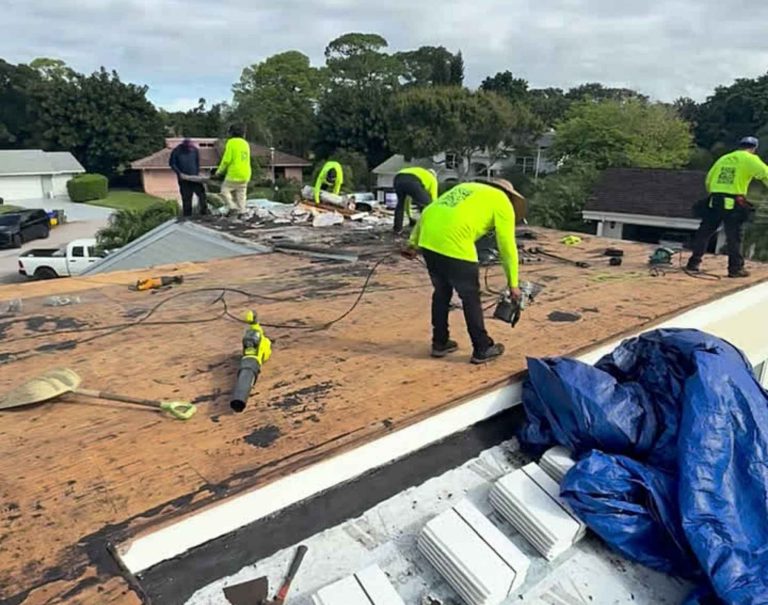
Phase 1 of Luxe Builder Group’s end-of-season assessment covers the exterior roofing surfaces — everything visible from the ground and from the roof surface itself — with specific attention to the conditions that six months of South Florida hurricane season produces on tile surfaces, flashing systems, penetrations, and drainage components. The Phase 1 inspector works systematically around the full perimeter of the property at ground level first, documenting conditions with dated photographs at each location, then accesses the roof surface for closer inspection of any location identified as requiring ground-level photography follow-up.
The tile surface assessment in Phase 1 focuses on three season-specific conditions. First — biological growth accumulation, documented by roof plane with estimated coverage percentage. Six months of sustained wet-season humidity produces the maximum annual biological growth accumulation on Tequesta tile surfaces, and December’s assessment captures this growth at its post-season density before the dry season’s lower humidity begins suppressing it. The Phase 1 biological growth documentation drives the cleaning scope specification — identifying which planes require cleaning, in what sequence, and with what treatment approach for the specific biological types (algae vs. lichen vs. combined) present on each surface. Second — tile displacement at hip and ridge locations, assessed for any movement that the season’s storm events or thermal cycling produced beyond the pre-season baseline. Third — mortar condition at all hip and ridge cap joints, assessed for cracking, separation, and loss of adhesion that the wet season’s sustained moisture and the season’s storm wind events produced.
The flashing and penetration assessment in Phase 1 specifically targets the windward-facing wall transitions and the penetration details that hurricane-season wind-driven rain stresses most severely. Luxe Builder Group’s protocol requires inspection at all four cardinal wall elevations — not just the elevations that faced the prevailing wind direction of the season’s most significant events — because wind-driven rain direction varies by storm track and a December assessment that omits the leeward elevations will miss the step flashing condition at a leeward wall transition that was stressed by a storm approaching from an unusual direction. Every pipe boot is visually assessed for cracking and separation at the boot-to-pipe interface, and any boot showing surface checking or loss of profile is marked for the Phase 2 contractor’s flex test verification.
The drainage assessment in Phase 1 covers gutters, downspouts, scuppers, and internal drain bowls — documenting the debris accumulation from six months of wet-season leaf, seed, and wind-deposited material that is now blocking or partially restricting every drainage pathway on the property. Luxe Builder Group’s protocol requires a drainage function test at every downspout and scupper — running water at the top of each downspout and confirming unobstructed flow at the discharge point — because a partial blockage that is invisible at visual inspection becomes hydraulically significant at the first wet-season rain intensity and can already be producing back pressure ponding damage at the scupper interior seal even before it appears as visible blockage from the ground.
Biological growth: documented by plane with coverage percentage — drives December cleaning scope Post-season biological growth is at maximum density in December. Documentation at this peak defines the cleaning scope with the precision that produces accurate pricing and the most effective cleaning sequence for each affected plane.
All four wall elevations inspected for flashing condition — not just the prevailing wind face Storm track direction varies. A December assessment that omits leeward elevations will miss the step flashing condition stressed by a storm approaching from an unusual quadrant. Luxe Builder Group’s protocol covers all four cardinal elevations without exception.
Drainage function test at every downspout and scupper — not just visual inspection A partial blockage invisible at visual inspection is hydraulically significant at wet-season rain intensity. Water flow testing at each outlet confirms function that visual inspection cannot verify — and identifies partial blockages before they become full ones.
Every pipe boot visually assessed — any surface checking or profile loss marked for Phase 2 flex test Surface checking visible on a pipe boot in December means the boot has reached or is approaching the end of its UV-limited service life. Marking these for Phase 2 flex test verification ensures the assessment recommendation is based on both visual and tactile evidence.
Phase 2 — Structural and Moisture Assessment: What the Season Deposited Below the Surface
Phase 2 of Luxe Builder Group’s end-of-season assessment moves from the visible exterior to the structural and moisture evidence that six months of hurricane season deposits in the roof assembly, the attic space, and the connection hardware. This phase requires attic access and, for properties where specific exterior findings in Phase 1 suggested possible water infiltration, careful deck assessment at the locations Phase 1 identified. Phase 2 is where the season’s accumulation failures — the slow moisture infiltrations that never produced interior evidence — are discovered or ruled out.
The attic moisture assessment in Phase 2 is Luxe Builder Group’s most diagnostic post-season procedure. The inspector enters the attic with a high-lumen flashlight and a non-invasive moisture meter — the type that reads moisture content in wood materials without requiring penetration — and systematically covers the full deck area from above the ceiling plane. The inspection sequence begins at the perimeter — where wall-to-roof flashing failures would deposit moisture at the top plate level — then moves inward to valley and ridge locations, then covers all penetration locations at pipe boots, vent pipes, and HVAC curbs. At each location, the inspector observes the underside of the deck plywood for color anomalies — fresh dark staining versus old dry staining — and uses the moisture meter to confirm whether any staining indicates current elevated moisture content. Any reading above ambient baseline triggers a detailed assessment of the specific location, photographed and measured for the written report.
The deck integrity assessment follows the moisture mapping — pressing on deck plywood at every location where elevated moisture was detected to confirm whether the moisture has produced softening or structural degradation. Soft deck plywood is active rot — a finding that requires immediate remediation before the dry season’s thermal cycling advances the decay. Firm stained deck plywood is historical moisture without current structural concern — documented for the homeowner’s record and monitored at the following April inspection for any advancement. The distinction between active rot and historical staining is critical to the remediation scope recommendation: active rot requires deck replacement before the next installation project or before the next season opens, while historical staining requires monitoring without immediate structural remediation.
The connection hardware assessment in Phase 2 covers the visible roof-to-wall strap connections at the attic perimeter — specifically assessing any rust advancement on strap surfaces that may indicate accelerating corrosion from wet-season moisture exposure. Galvanized straps in Tequesta’s coastal HVHZ environment have a finite service life before zinc depletion — and the annual post-season assessment is the mechanism for tracking corrosion advancement year over year and identifying the threshold at which strap replacement becomes necessary before the next season’s peak wind loading. Luxe Builder Group’s written report records the strap condition with photographs at a representative sample of perimeter connection points, creating the multi-year corrosion progression record that supports the strap replacement recommendation when the threshold is reached.
Phase 3 — Documentation and Forward Planning: Closing the Year and Opening the Next
Phase 3 of Luxe Builder Group’s end-of-season assessment is the documentation and forward planning phase — the step that converts the Phase 1 exterior findings and Phase 2 structural and moisture findings into a written condition report, a dated photograph archive, and a specific action plan for the dry season ahead. This phase is what distinguishes a professional post-season assessment from an inspection visit — the systematic organization of all findings into a permanent, independently verifiable record that the homeowner can use for insurance, transactions, and contractor discussions for years after the assessment date.
The written condition report produced at Phase 3 covers every finding from Phases 1 and 2 in a structured format: location, observed condition, assessment classification (immediate action required, monitor at next inspection, or serviceable — no action required), and recommended action with estimated cost range where applicable. Every finding is referenced by a numbered photograph in the accompanying photograph archive — creating a one-to-one correspondence between the written finding and the visual evidence that allows the homeowner, their insurance agent, and any future contractor to locate the specific condition on the property without requiring Luxe Builder Group’s re-attendance. The report is dated, signed by the licensed CCC contractor who conducted the assessment, and formatted for use as a disclosure document or insurance support letter without modification.
The forward planning section of the Phase 3 report prioritizes the identified action items by urgency and optimal execution timing — distinguishing between conditions that require action before the dry season’s thermal cycling advances them (immediate action, December or January), conditions that are appropriate for scheduled dry-season project execution (planned action, January through March), and conditions that should be monitored at the April pre-season inspection before any action decision is made (monitoring items). This prioritization framework gives the homeowner a clear, phased action plan rather than an undifferentiated list of findings that leaves the timing and sequencing decisions to the homeowner’s judgment.
The final element of Phase 3 is the annual documentation file compilation — Luxe Builder Group’s practice of organizing the current year’s full roofing record into a single dated file that joins the property’s permanent roofing documentation archive. This file includes the April pre-season inspection report, any maintenance visit records from the year, any storm event photographs taken during the season, and the December end-of-season assessment report with its complete photograph archive. When the homeowner provides this file to a future buyer’s due diligence team, a future insurance underwriter, or a future contractor who needs to understand the property’s roofing history, they are providing a multi-year record that demonstrates continuous professional management — the most persuasive evidence of property care available in the Tequesta market.
Written condition report with numbered photographs — every finding cross-referenced to visual evidence The one-to-one correspondence between written finding and numbered photograph allows the homeowner, insurer, and future contractor to locate every condition on the property without requiring Luxe Builder Group’s re-attendance. This is what makes the report independently usable years after the assessment date.
Forward planning section: immediate, planned, and monitoring items with optimal timing for each A phased action plan rather than an undifferentiated finding list. Immediate action items (December or January), planned dry-season project items (January through March), and monitoring items (assess at April inspection) — each with optimal execution timing and estimated cost range.
Annual documentation file compiled — current year joins the permanent property roofing archive April report, maintenance records, storm photographs, December assessment — organized into a single dated file that joins prior years in the property’s roofing documentation archive. Multi-year annual files are the most persuasive professional management evidence available in this market.
Next April inspection booked before leaving the assessment appointment — lock the annual cadence Luxe Builder Group’s holds April slots for clients who book them in December. The homeowners whose April inspection slots are guaranteed year after year are the ones who established this habit at the end of every December assessment. Book it before leaving — every year.