In This Article
Gutters are the most underspecified component in the typical Tequesta or Jupiter Island luxury home — purchased on price, installed as an afterthought, and ignored until they fail. The failure consequences are disproportionate to the investment: water at the foundation, landscape erosion, fascia rot, and soffit deterioration that creates wildlife entry points and accelerates the decay of the roof edge assembly. In a coastal salt air environment with Florida’s rainfall intensity, gutter system specification is a material engineering decision, not a commodity purchase. Getting it wrong costs far more than getting it right.
Why Gutters Matter More in Florida Than Most Places
Florida’s rainfall pattern creates gutter loading conditions that are fundamentally different from the gradual, sustained rainfall events that dominate northern climates. Palm Beach County receives an average of 62 inches of rainfall annually — but the distribution is highly concentrated. Summer afternoon convective storms can deliver 2 to 4 inches of rain in under an hour at intensities of 4 to 6 inches per hour. This brief, intense loading pattern overwhelms undersized gutter systems entirely, sending the full roof drainage volume cascading off the eave and directly against the foundation and soffit assembly below.
The foundation consequences of inadequate gutter drainage are particularly significant for the concrete slab-on-grade construction that dominates residential building in Tequesta and Jupiter. Repeated saturation of the soil immediately adjacent to the foundation creates conditions for slab edge deterioration, settlement, and in severe cases structural movement. Insurance adjusters in Palm Beach County regularly attribute foundation claims to long-term inadequate roof drainage — a causal chain that begins with undersized or failed gutters.
“Florida delivers 4 inches of rain in 45 minutes. A gutter system sized for gradual New England rainfall is not undersized — it is functionally absent during the events that matter most.”
Material Selection for a Salt Air Environment
The coastal salt air environment of Tequesta and the Palm Beaches eliminates two of the most commonly specified gutter materials — galvanized steel and standard vinyl — from consideration entirely. Galvanized steel corrodes predictably and rapidly in high-deposition salt air environments. The zinc coating that provides galvanized steel’s corrosion protection is consumed by salt-accelerated electrochemical reactions at a rate that typically exhausts the coating within 8 to 12 years, after which base steel corrosion proceeds rapidly. Vinyl gutters in Florida’s UV and thermal environment become brittle, fade, and develop stress cracks at hanger locations within 10 to 15 years — well short of the 30-year performance horizon appropriate for a luxury residential property.
Aluminum is the baseline acceptable material for gutter systems in coastal Palm Beach County, and the specification detail that matters most is the alloy and coating. Standard residential aluminum gutter stock — typically 0.027-inch thickness in an unspecified alloy — is adequate for properties beyond the immediate salt spray zone. For properties within 1,500 feet of salt water, 0.032-inch thickness in a marine-grade alloy with a factory-applied Kynar or PVDF coating provides materially better corrosion resistance and a service life approaching 25 to 30 years.
No galvanized steel within the salt spray zone Zinc coating exhaustion in high-deposition salt environments produces an 8-to-12-year replacement cycle on a component that should last 30 years.
Aluminum minimum 0.032-inch for coastal properties Standard 0.027-inch residential stock is insufficient for the thermal cycling and wind loading of coastal Palm Beach County. Specify gauge explicitly in any contract.
Copper is the 50-year specification for luxury estates The only common gutter material that improves with coastal exposure. Appropriate when the roofline architecture warrants the investment and maintenance elimination is a priority.
Type 316 stainless for intermediate applications Molybdenum content provides chloride resistance that Type 304 lacks. The correct stainless specification for properties within the coastal salt spray zone.
Sizing Gutter Systems for Florida Rainfall Intensity
Gutter sizing in Florida requires a rainfall intensity calculation based on the actual design storm intensity for Palm Beach County, not the national average figures embedded in standard residential gutter sizing charts. The standard residential gutter sizing methodology — which specifies 5-inch K-style gutters for most residential applications — was developed for national average rainfall intensities of 1 to 2 inches per hour. Palm Beach County design storm rainfall intensity at the 10-year return period exceeds 4.5 inches per hour. Applying standard sizing methodology to a Florida coastal property produces a gutter system that is undersized by a factor of 2 to 3 for the design storm event.
The correct approach to Florida residential gutter sizing begins with the roof drainage area calculation — the horizontal projected area of roof surface that drains to each gutter run — combined with the design rainfall intensity for Palm Beach County at the appropriate return period. For luxury residential applications where interior water intrusion or foundation damage during a significant storm event is an unacceptable outcome, we size to the 25-year return period rainfall intensity, which in Palm Beach County approaches 6 inches per hour for short-duration events.
“Standard 5-inch gutter sizing methodology was developed for 1-inch-per-hour rainfall. Palm Beach County delivers 4.5 inches per hour. The math on undersized gutters resolves itself during the first significant storm.”
Attachment Systems and Maintenance Requirements
Gutter attachment to the fascia is the mechanical failure point that most commonly precedes gutter system failure in Palm Beach County. The standard spike-and-ferrule attachment system — a long nail driven through the gutter face and ferrule into the fascia — pulls out under the combined weight of a water-charged gutter during a Florida rainstorm. The weight of water in a 6-inch gutter fully charged during a peak intensity event approaches 3 to 4 pounds per linear foot. Spike attachment systems are not designed for this sustained loading in the aluminum fascia construction typical of Florida residential homes.
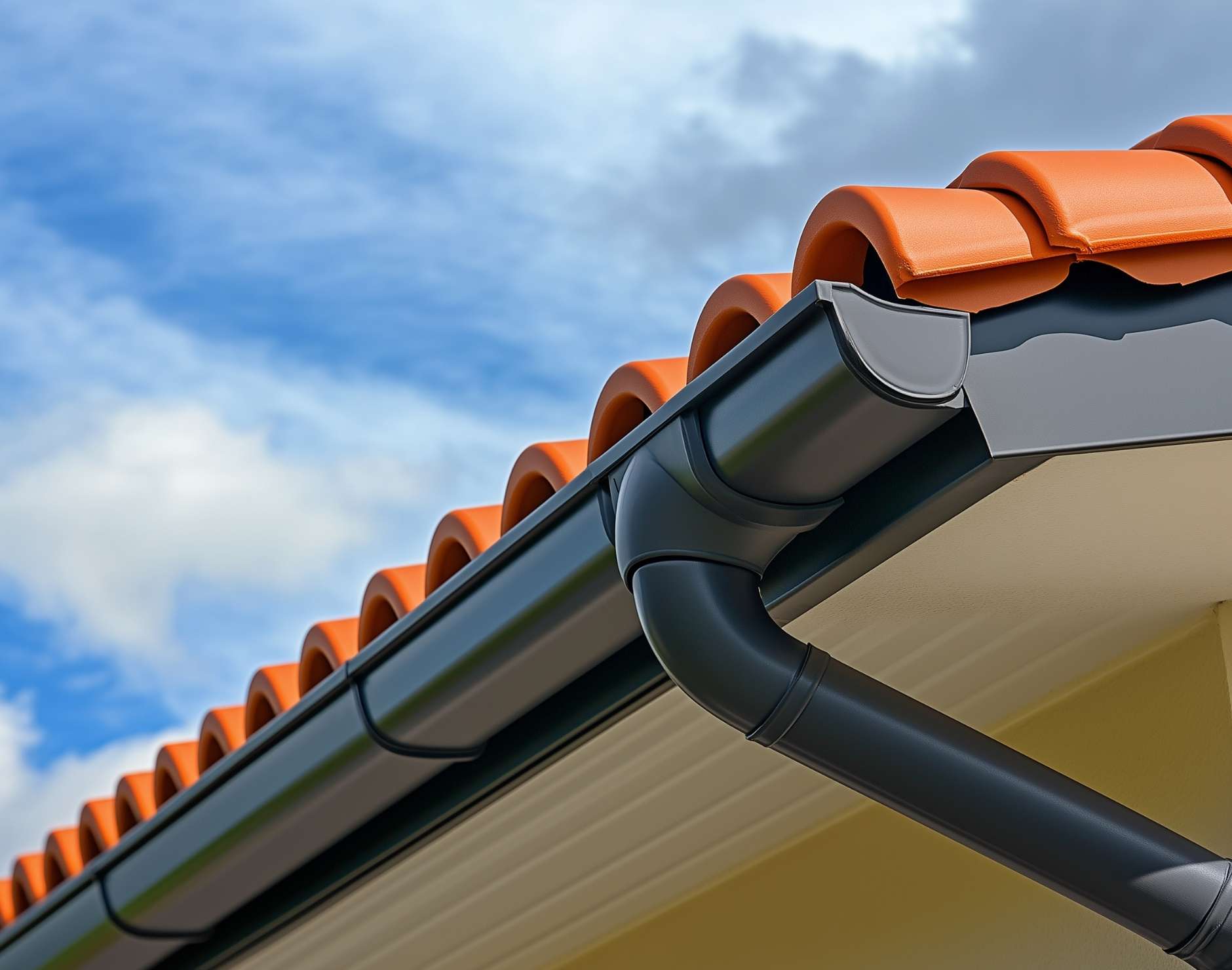
Hidden hanger systems that clip inside the gutter profile and attach through the gutter back to the fascia with structural screws provide attachment strength approximately 4 times greater than spike systems — and they do so without creating a penetration through the gutter face that becomes a corrosion initiation point. Hidden hanger spacing of 18 to 24 inches is the correct specification for Florida rainfall loading. Spacing beyond 24 inches allows gutter deflection under load that creates back-pitch — trapped water zones that accelerate corrosion and create overflow conditions during moderate rainfall events.
Hidden hanger systems only — no spike and ferrule Spike attachment fails under Florida rainfall loading. Hidden hangers at 18-to-24-inch spacing provide 4x the attachment strength with no gutter face penetration.
Twice-annual cleaning minimum May and November cleaning aligns with pre- and post-hurricane season. Salt and organic debris combination accelerates corrosion at joints and hanger contact points.
6-inch gutters and 3×4-inch downspouts for Florida sizing Standard 5-inch and 2×3-inch specifications are undersized for Palm Beach County rainfall intensity. Upgrade to 6-inch gutters and 3×4 downspouts at 12-foot spacing.
Solid reverse-curve guards only if guard system is desired Fine-mesh guards clog with Florida palm pollen and organic fines. Plastic guards degrade under UV. Aluminum or stainless reverse-curve systems are the only durable option.