In This Article
Positive drainage is the single most important design requirement for any flat or low-slope roof in South Florida — and the most frequently compromised during both original construction and re-roofing projects. Florida’s rainfall intensity makes drainage deficiency on a flat roof not a latent risk but a guaranteed failure event: a flat roof section that ponds water after a 4-inch-per-hour rainstorm will pond water on every subsequent rainstorm for the life of the roofing system, voiding most membrane warranties, accelerating membrane degradation, and creating the structural loading conditions that are responsible for a significant portion of the flat roof collapse events documented in Palm Beach County building records.
Why Flat Roof Drainage Fails in Florida
The root causes of flat roof drainage failure in Tequesta and Jupiter Island fall into three categories: inadequate slope at original design, drain undersizing for Florida rainfall intensity, and drain obstruction through organic debris accumulation. Each failure mode produces the same outcome — ponding water — but through different mechanisms, and each requires a different remediation approach. Misidentifying the root cause produces a repair that addresses the symptom without resolving the underlying problem.
Inadequate slope is the most fundamental drainage failure and the most difficult to remediate after construction. Florida Building Code requires a minimum slope of 1/4 inch per foot for flat roof membranes — the absolute minimum that can sustain positive drainage to a drain or scupper. In practice, the combination of construction tolerance variability, structural deflection under load, and long-term settlement of the building frame means that roofs designed to the minimum slope frequently develop low spots that pond water within the first few years of service. The corrective specification for inadequate slope is tapered insulation — polyisocyanurate boards fabricated to specific slope profiles that create positive drainage geometry on an otherwise level deck.
“Eight inches of ponding water on a 1,500-square-foot flat roof section weighs over 48,000 pounds — a structural load that most residential roof framing was not designed to resist. Overflow protection is not optional in Palm Beach County.”
Scuppers vs. Interior Drains: The Florida Design Choice
The choice between scupper drainage and interior drain systems for residential flat roofs in Tequesta and Jupiter Island is primarily a function of the roof’s parapet configuration, the building’s structural drainage routing, and the maintenance accessibility of the drainage components. Both systems can be correctly specified for Florida’s rainfall intensity — the critical variable is whether the system is sized for actual Florida design storm conditions rather than national average values.
Scupper drainage — openings through the parapet wall at the roof membrane level that direct drainage off the roof edge — offers the primary maintenance advantage of visual inspectability. A scupper opening is accessible for cleaning from a ladder without requiring roof access, and a blocked scupper is immediately apparent from the ground when water is not flowing through it during a rainstorm. The design requirement for Florida scuppers is sizing: each scupper opening must be large enough to discharge the full design storm flow for its contributing roof area. For Palm Beach County’s design storm intensity, a scupper sized for a 1,000-square-foot contributing area requires a minimum opening of 4 inches by 8 inches — significantly larger than the decorative scupper sizes that are commonly installed for aesthetic reasons.
Size drains for Florida design storm intensity — not national averages Palm Beach County’s 4.5-inch-per-hour design storm intensity requires drain sizing 2–3 times larger than IPC standard tables produce. Always verify sizing against local rainfall data.
Scupper minimum 4×8 inches for 1,000 sq ft contributing area Decorative scuppers sized for appearance rather than hydraulic capacity are functionally absent during Florida design storm events. Size for function, then design for aesthetics.
Combined primary and emergency drainage for luxury residential Interior drains for primary drainage combined with emergency overflow scuppers at 2-inch parapet height. Redundancy that eliminates the catastrophic blocked-drain scenario.
Twice-annual drain cleaning minimum May before hurricane season and November after. Palm debris and organic fines in coastal Palm Beach County block drain strainers faster than any other market in the country.
Overflow Protection: The Code Requirement Most Roofs Lack
Florida Building Code and the International Building Code both require overflow drainage provisions for any roof with a parapet or other barrier that could retain water if primary drainage is obstructed. The overflow requirement is based on a straightforward structural engineering reality: the design live load for most residential roof structures is 20 pounds per square foot. Water at 5.2 pounds per gallon accumulates to 20 pounds per square foot at approximately 4 inches of depth. A flat roof section with obstructed primary drainage and no overflow protection in a Florida design storm event will accumulate water depth well beyond 4 inches — loading the roof structure to multiples of its design capacity.
The overflow protection requirement is satisfied through one of two design approaches: secondary overflow drains set 2 inches above the primary drain elevation, or emergency scupper openings through the parapet wall set at a height that limits maximum ponding depth to the structural capacity of the roof framing. For most residential applications, the emergency scupper approach is simpler to install and maintain — it requires no internal drainage routing and is visually inspectable from outside the building.
“A flat roof with a parapet and no overflow scuppers is one blocked drain away from a structural loading event. In a market where 4 inches of rain falls in 45 minutes, that event is not theoretical.”
Tapered Insulation Systems: Creating Positive Drainage on Flat Decks
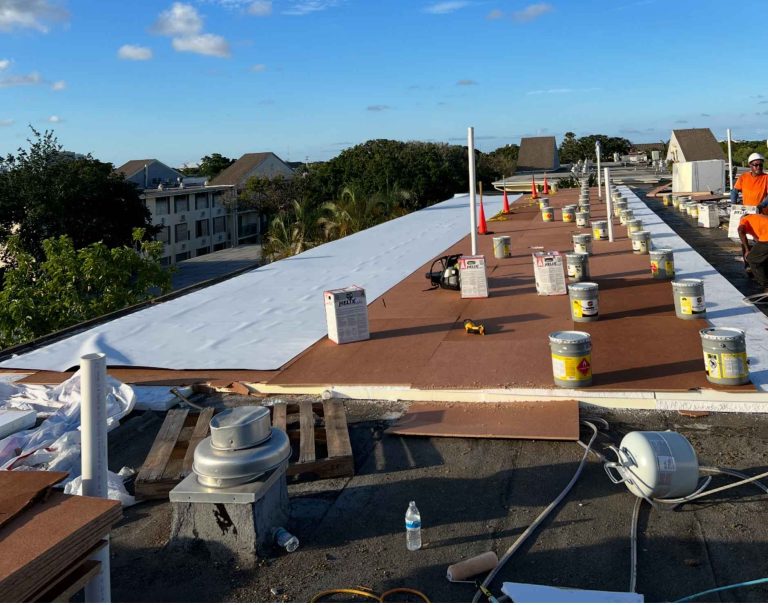
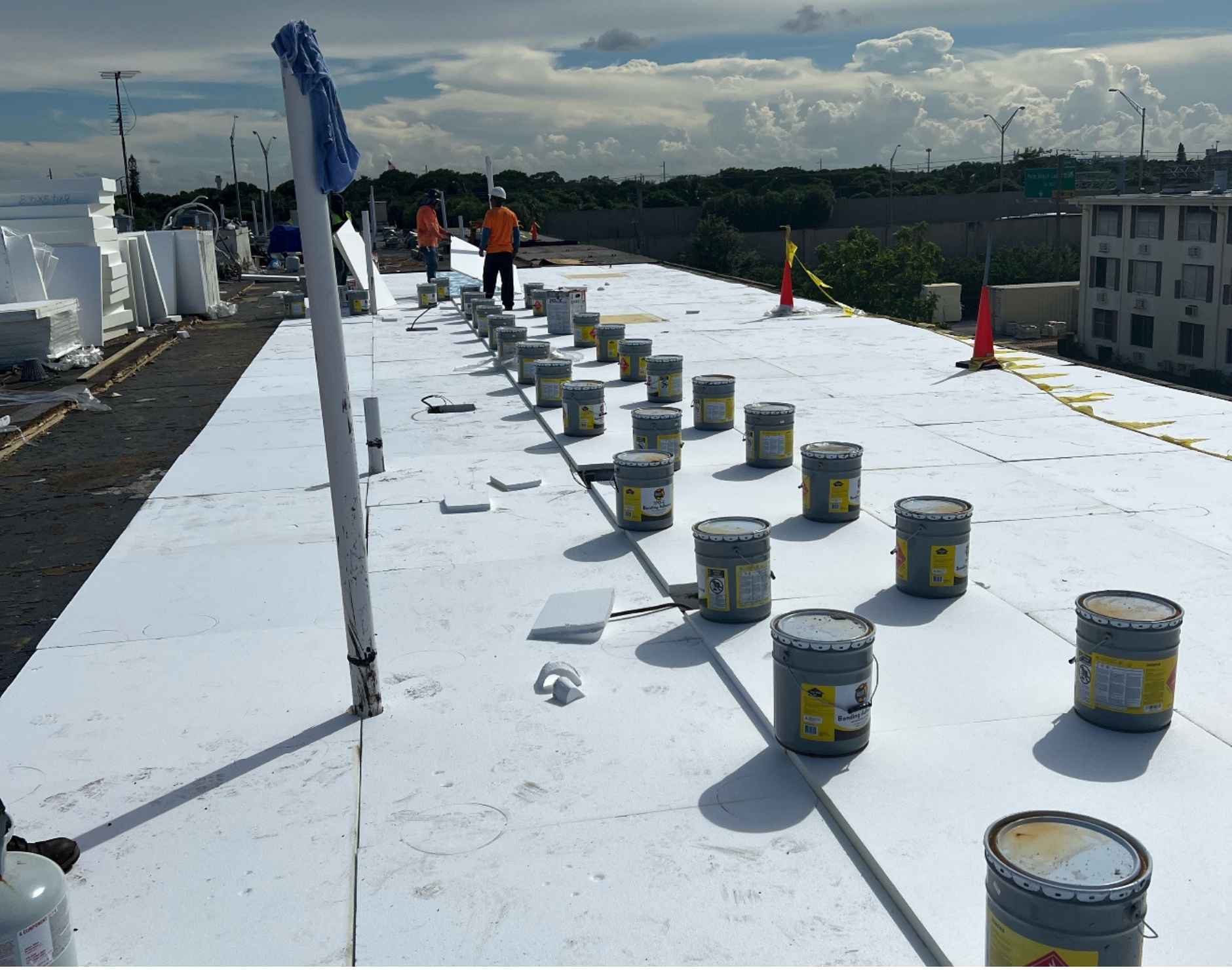
Tapered insulation is the engineering solution for flat roofs that lack adequate structural slope for positive drainage — a condition that is extremely common in the existing residential building stock of Tequesta and Jupiter, particularly in pre-2000 construction where minimum slope requirements were less stringently enforced. Rather than modifying the structural deck to create slope — an intervention that requires structural engineering and significant framing work — tapered insulation achieves positive drainage geometry by varying the thickness of polyisocyanurate insulation boards across the roof area.
A tapered insulation system begins with a survey of the existing roof surface to identify low points and drainage paths. The insulation manufacturer then fabricates custom-thickness boards in the profile needed to create uniform 1/4-inch-per-foot slope from each high point to the drain or scupper location. The result is a new positive drainage geometry installed above the existing deck, with no structural modification required. For re-roofing projects where the existing flat roof has documented ponding problems, tapered insulation is a mandatory component of any new membrane installation — applying a new membrane over a drainage-deficient geometry reproduces the same failure mode on a new system.
Require tapered insulation on any re-roof with documented ponding A new membrane on a ponding-prone geometry reproduces the same failure on a new system. Tapered insulation is not optional when slope deficiency is identified.
Tapered ISO adds R-6 per inch of insulation value The drainage correction and the energy improvement are a single installation. For flat sections above conditioned space in South Florida, this dual benefit changes the ROI calculation significantly.
Shop drawings required before fabrication Tapered layout is an engineering exercise, not a field call. Watershed boundaries, drain locations, and board thickness profiles must be designed and reviewed before material is ordered.
Crickets and saddles at all penetrations Equipment curbs, HVAC platforms, and large penetrations create drainage shadows that accumulate ponding even in otherwise well-sloped systems. Crickets eliminate these low points.