In This Article
Flat roof sections are a common feature of Tequesta luxury homes — appearing as covered lanais, garage roofs, second-floor terrace decks, and low-slope transitions between the main tile or metal roof and lower-level additions. These sections are almost universally the most maintenance-intensive part of any Tequesta property’s roofing system, and they are consistently the first areas to develop leaks because low-slope and flat roof membranes face the most direct ponding water exposure, the highest thermal cycling stress, and the most concentrated UV load of any roofing surface on the property. Choosing the correct membrane system for Tequesta’s specific combination of heat, UV, salt air, and hurricane rain volume — and installing it to the standard that this environment demands — is the decision that determines whether a flat roof section lasts 15 years or 25 years between replacements.
Flat Roofing in Tequesta’s Climate — What This Environment Demands
Tequesta’s flat roof environment is among the most demanding in the continental United States for membrane roofing systems. The combination of factors that create this demanding context operates simultaneously and reinforces each other in ways that accelerate the degradation of inadequately specified membrane systems well beyond their design life expectations.
UV radiation intensity in South Florida is among the highest in North America — approximately 50 to 60% higher than in northern states — and flat roof membranes receive this radiation at near-perpendicular incidence throughout the high-sun months, maximizing the photochemical degradation that progressively reduces membrane flexibility, seam strength, and puncture resistance. Both TPO and modified bitumen degrade under UV exposure — the rate and pattern of that degradation differs between the two systems and between different quality grades within each system, and the implications for service life in Tequesta are meaningful.
Thermal cycling in South Florida’s climate is extreme by national standards. The daily temperature swing between early morning low and midday peak at a flat roof surface can reach 80 to 100°F in summer — from approximately 75°F air temperature at dawn to 170 to 180°F at the membrane surface in direct midday sun. This thermal cycle drives daily expansion and contraction at the membrane and at every seam and penetration detail. Over thousands of cycles across a 15 to 20-year service life, the cumulative fatigue at seams — particularly at laps, terminations, and penetration flashings — is the primary failure mechanism for both TPO and modified bitumen in South Florida.
TPO — What It Is and How It Performs in Tequesta
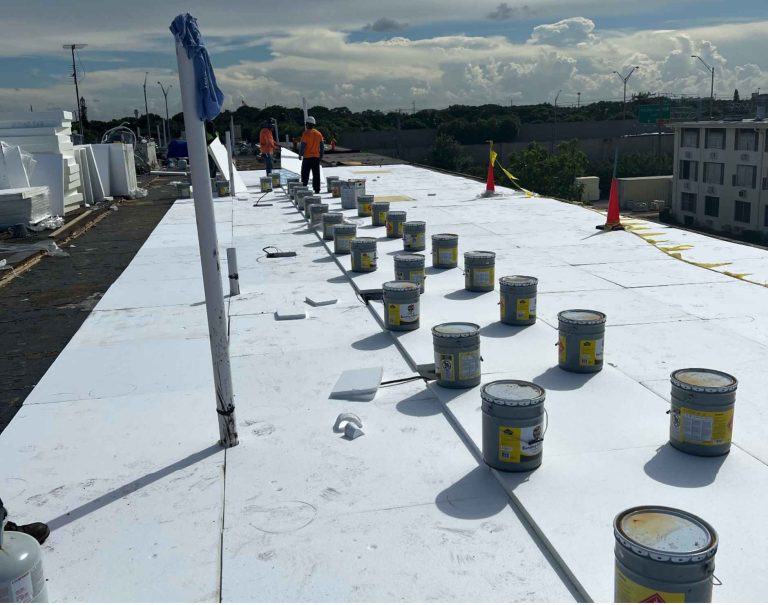
Thermoplastic Polyolefin — TPO — is a single-ply membrane roofing system consisting of a polyolefin thermoplastic compound reinforced with a polyester scrim or fiberglass mat. It is heat-welded at seams using hot-air welding equipment, producing monolithic seam bonds that — when executed correctly — are stronger than the membrane itself. TPO has become the dominant commercial and residential flat roofing system in the United States over the past 20 years, displacing EPDM rubber roofing in most applications because of its superior UV resistance, reflectivity, and heat-weld seam technology.
In Tequesta’s climate, TPO’s primary performance advantages are its high solar reflectance — white and light gray TPO membranes reflect 70 to 80% of incident solar radiation, dramatically reducing the roof surface temperature and the thermal cycling stress at the membrane — and its resistance to biological growth establishment. TPO’s smooth, non-porous surface does not support algae or lichen establishment in the way that granule-surfaced modified bitumen does, eliminating a maintenance requirement that accumulates cost on mod-bit installations over their service life.
The primary performance limitation of TPO in Tequesta’s environment is seam integrity over time under the combined thermal cycling and UV exposure conditions. Early-generation TPO membranes — particularly those installed before approximately 2005 — had documented seam brittleness issues after 10 to 15 years of South Florida exposure, as the compound’s plasticizer migrated out under the heat stress and the seam welds became rigid and susceptible to cracking at the lap edge. Modern TPO formulations have substantially improved seam flexibility retention over the previous generation — but the quality variation within the current TPO market is significant, and the difference between a 45-mil membrane from a major manufacturer with documented South Florida track record and an off-brand 45-mil membrane from a budget supplier is not visible at installation and is only revealed over years of service.
TPO advantage: highest solar reflectance — dramatically reduces thermal cycling stress White TPO reflecting 70–80% of incident solar radiation reduces membrane surface temperature by 50 to 70°F compared to dark-colored membranes — the single most effective means of extending membrane service life in Tequesta’s heat environment.
TPO advantage: smooth surface resists biological growth — eliminates a maintenance cycle No granule surface means no biological growth substrate. TPO flat roofs in Tequesta do not require the biological cleaning cycles that granule-surfaced modified bitumen accumulates over its service life.
TPO limitation: membrane quality varies significantly — specify manufacturer and mil thickness 60-mil TPO from a major manufacturer with documented Florida track record is a fundamentally different product from 45-mil budget-grade TPO. Always specify manufacturer, membrane thickness, and reinforcement type — not just “TPO membrane.”
Zone 1 waterfront: fully adhered TPO over mechanically attached for uplift resistance For Intracoastal, river, and inlet-adjacent Tequesta properties where wind uplift calculations produce maximum pressures, fully adhered TPO provides superior resistance to the hurricane uplift forces that challenge mechanically attached installations.
Modified Bitumen — What It Is and How It Performs in Tequesta
Modified bitumen — commonly called mod-bit — is a multi-layer flat roofing system based on asphalt modified with either APP (atactic polypropylene) or SBS (styrene-butadiene-styrene) polymer to improve flexibility, UV resistance, and temperature performance relative to traditional built-up roofing. APP-modified bitumen is characterized by excellent heat resistance and UV stability — properties that align well with South Florida’s thermal environment — while SBS-modified bitumen provides superior flexibility at low temperatures but is somewhat less UV-resistant in direct tropical exposure.
In Tequesta’s climate, APP-modified bitumen is the correct specification — SBS’s low-temperature flexibility advantage is irrelevant in a climate that rarely experiences temperatures below 50°F, and APP’s superior heat resistance and UV stability are the performance attributes that matter most in South Florida’s thermal environment. A two-ply APP modified bitumen system — base sheet plus cap sheet — with a reflective mineral granule or aluminum coating surface provides a robust, time-proven flat roofing specification that has performed well throughout the Florida coastal market for decades.
The primary performance advantage of modified bitumen over TPO in Tequesta is redundancy. A two-ply mod-bit system provides two waterproofing layers — a failure at any location in the cap sheet is arrested by the intact base sheet below it, providing time for discovery and repair before the failure propagates to the deck. TPO’s single-membrane configuration means that any through-membrane failure — from puncture, seam failure, or penetration detail failure — is immediately a deck-level leak event with no second line of defense. In a maintenance context, the redundancy of two-ply modified bitumen is a meaningful advantage for property owners who inspect their flat roof sections less frequently than optimal.
The primary performance limitations of modified bitumen in Tequesta are its lower solar reflectance relative to white TPO and its biological growth susceptibility on the granule surface. A standard mineral granule-surfaced mod-bit cap sheet absorbs 80 to 90% of incident solar radiation — the opposite of white TPO’s reflective profile — producing membrane surface temperatures that drive accelerated oxidation of the asphalt compound and shorten the realistic service life relative to what the same membrane would achieve in a less thermally demanding climate. This limitation can be partially addressed through aluminum-coated cap sheets or the application of reflective roof coatings, but these are maintenance items that add recurring cost to the lifecycle comparison with TPO.
The Tequesta Decision Framework — Which System for Which Property
The TPO vs. modified bitumen decision for a Tequesta flat roof section is best made through a property-specific framework that weighs the performance factors most relevant to the specific section’s size, usage, drainage conditions, solar exposure, access frequency, and holding horizon. Neither system is universally superior for all Tequesta applications — the correct choice depends on the specific combination of these variables for each property and each flat roof section.
TPO is the preferred specification for large, regularly inspected flat roof sections with good positive drainage and high solar exposure — the conditions where TPO’s reflectivity advantage has the greatest thermal performance impact, where its smooth surface’s biological resistance saves the most maintenance cost, and where the single-membrane configuration’s vulnerability to through-failure is managed by regular inspection that catches seam or penetration issues before they become significant leak events. Large covered lanai roofs, second-floor terrace decks with accessible surfaces, and garage roof sections that are regularly visible and inspectable are all strong TPO candidates. Specify 60-mil minimum thickness, fully adhered installation in Zone 1 applications, and a manufacturer with documented Florida coastal track record.
Modified bitumen is the preferred specification for smaller flat roof sections with limited inspection access, for sections adjacent to living spaces where a leak event would be immediately consequential, and for applications where the redundancy of a two-ply system is worth the thermal performance trade-off. Flat roof sections over bedrooms, bathrooms, or interior living areas on Tequesta homes — where a through-failure produces immediate interior damage before the leak is discovered — benefit from mod-bit’s two-ply redundancy in a way that outweighs TPO’s thermal performance advantage. Specify APP-modified bitumen cap sheet with aluminum coating or reflective mineral surface for maximum UV resistance, torch-applied or self-adhering installation depending on deck substrate, and two-ply configuration throughout.
Large, accessible, regularly inspected sections with positive drainage: specify TPO 60-mil TPO’s solar reflectance advantage and maintenance-free surface are most valuable on large exposed sections where regular inspection manages the single-membrane vulnerability. Fully adhered in Zone 1 applications.
Sections over interior living spaces with limited access: specify two-ply APP mod-bit Two-ply redundancy arrests cap sheet failures before they become deck leaks — critical for sections where a through-failure produces immediate consequential interior damage before discovery. Aluminum coating or reflective mineral surface for UV resistance.
Hybrid specifications are correct for properties with diverse flat roof sections Using the same membrane everywhere for contractor convenience is not the correct approach when sections have meaningfully different use, access, and consequence profiles. A properly designed Tequesta flat roof specification matches system to section conditions.
Always specify drainage design explicitly — positive slope to drain is the foundation Every flat roof section in Tequesta requires positive slope to drain — minimum 1/4-inch per foot to scuppers or internal drains sized for the South Florida 100-year rain event. Ponding water is the primary accelerant of membrane degradation regardless of system type.