In This Article
Metal roofing has become the premium specification of choice for a growing share of luxury residential projects in the Tequesta and Jupiter Island market — driven by its combination of exceptional wind resistance, long service life, and architectural versatility that tile cannot match for certain home styles and site conditions. But “metal roofing” is not a single product — it is a broad category that includes two fundamentally different systems with meaningfully different performance characteristics, maintenance requirements, service life profiles, and suitability for the coastal HVHZ environment. Standing seam metal roofing and exposed fastener metal roofing share a material substrate but differ in the mechanism that determines their long-term performance — and that difference matters significantly in the Palm Beach County coastal environment where thermal cycling, salt air, and hurricane wind loads all work together to stress every roofing fastener on your home.
The Fundamental Structural Difference Between the Two Systems
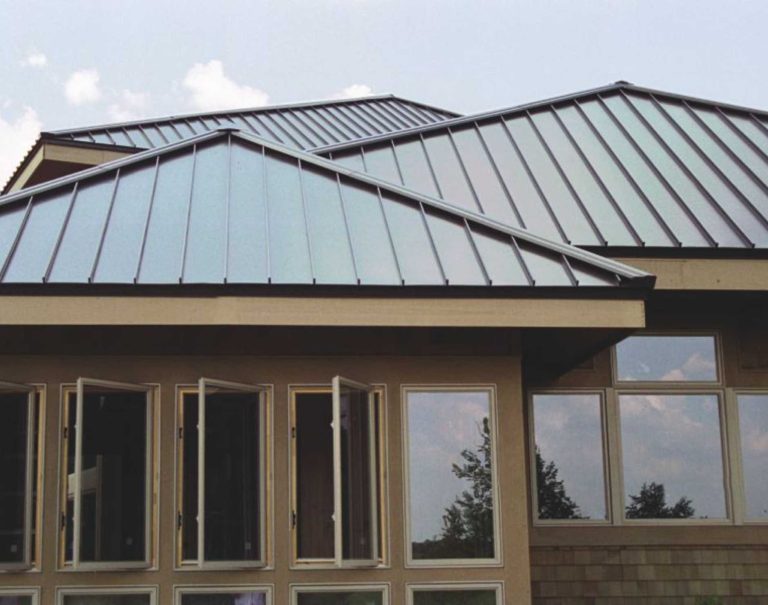
The defining difference between standing seam and exposed fastener metal roofing is the location and type of attachment between the metal panel and the roof structure — specifically, whether the fasteners that secure the panels are exposed to the weather or concealed beneath the panel surface.
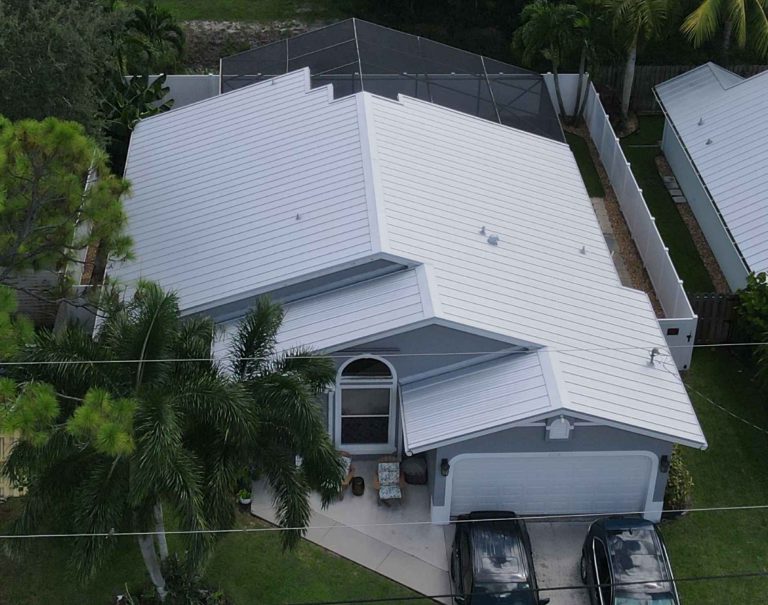
In an exposed fastener system — also called through-fastened or screw-down metal roofing — each metal panel is secured to the roof structure with screws or nails that penetrate through the face of the panel. The fastener head is visible on the finished roof surface, typically covered by a rubber or neoprene washer that compresses against the panel surface to create a seal at the fastener penetration. The panel-to-panel joints may be flat laps or simple ribs, but in all cases the primary attachment is through the panel face.
“An exposed fastener metal roof has thousands of panel face penetrations, each sealed by a rubber washer that degrades in South Florida’s UV environment. A standing seam roof has zero panel face penetrations. That difference defines everything about long-term performance.”
Performance Comparison in the Florida Coastal Environment
The performance comparison between standing seam and exposed fastener metal roofing in the Tequesta and Jupiter coastal environment reveals meaningful differences in four key categories: water resistance over time, thermal movement management, wind uplift resistance, and maintenance requirement.
Water resistance over time is the category where the difference between the two systems is most dramatic. An exposed fastener system’s neoprene or EPDM washers — the components that seal each panel face penetration — have a realistic service life of 10 to 20 years in South Florida’s UV and ozone exposure before they become brittle and begin to crack or shrink away from the fastener shank. When washer integrity fails at a fastener location, that location becomes a water entry point during rain events. With hundreds to thousands of fastener locations per roof, the statistical probability of multiple washer failures within any given year increases as the system ages — producing a maintenance requirement that escalates over time rather than remaining constant.
Water resistance: standing seam has zero panel face penetrations Exposed fastener systems develop water entry points as washers age — a maintenance liability that escalates with time. Standing seam systems eliminate this failure mode entirely through concealed clip attachment.
Thermal movement: standing seam panels float freely over clips Fixed attachment in exposed fastener systems creates thermal fatigue stress at every fastener location. Standing seam’s floating clip design eliminates this stress, preventing panel deformation and fastener hole elongation over time.
Wind uplift: standing seam clip rating is engineered and verifiable Clip selection and spacing can be specified to meet site-specific ASCE 7-22 pressure zone requirements. This engineered approach to uplift resistance is a more reliable HVHZ compliance path than exposed fastener systems.
Maintenance: standing seam is essentially maintenance-free for 20–30 years No washers to inspect, no fasteners to re-torque, no sealant to reapply. The exposed fastener system requires a 5–10-year maintenance cycle in the coastal environment — a recurring cost that compounds over the system’s life.
Cost, Value, and Lifecycle Economics
The installed cost differential between standing seam and exposed fastener metal roofing is the most commonly cited reason homeowners choose exposed fastener systems — and it is also the most commonly misunderstood comparison in the metal roofing decision. The upfront cost differential is real but smaller than many contractors represent, and the lifecycle economic advantage of standing seam is substantial enough to make it the correct choice for virtually every luxury residential application in Palm Beach County.
The installed cost of a quality standing seam aluminum roofing system with Kynar coating on a typical Tequesta luxury home — 3,000 to 5,000 square feet of roof area — is approximately $25 to $45 per square foot installed, producing total project costs in the $75,000 to $225,000 range depending on roof complexity. A quality exposed fastener system on the same home would be installed at $18 to $28 per square foot, producing total costs of $54,000 to $140,000. The differential — approximately $30,000 to $85,000 depending on project scope — represents the upfront premium for standing seam.
“Over a 50-year horizon, standing seam installed once costs less than exposed fastener installed once plus multiple maintenance cycles plus one re-roofing project. The upfront premium is real. The lifecycle advantage is larger.”
Choosing the Right System for Your Home
The decision framework for metal roofing system selection in Palm Beach County should begin with holding horizon and total cost of ownership, not upfront cost. For a homeowner planning to hold a luxury coastal property for 15 or more years — or indefinitely — the standing seam system is the correct choice for every application where the architecture is compatible with the panel profile and the budget can accommodate the premium. The lifecycle economics are unambiguous, the maintenance advantage is significant, and the resale value impact is positive.
Exposed fastener metal roofing has legitimate applications in the Palm Beach County market — specifically for accessory structures, garages, covered outdoor living spaces, and secondary buildings where the aesthetic is appropriate and the holding horizon is shorter. On a primary residence that the homeowner plans to hold for decades and eventually sell in the luxury market, an exposed fastener specification is a value-compromising choice relative to standing seam — both in long-term maintenance cost and in the resale market perception of buyers who know the difference.
For luxury primary residences held 15+ years — standing seam is the clear choice Lifecycle economics, maintenance advantage, wind performance, and resale value all favor standing seam for long-hold luxury coastal properties. The upfront premium is recovered through lower maintenance and higher resale positioning.
Exposed fastener is appropriate for accessory structures and secondary buildings Garages, covered living areas, and secondary structures where the aesthetic is compatible and the holding horizon is shorter are legitimate exposed fastener applications. The primary residence deserves standing seam.
Specify Kynar PVDF coating — not polyester or SMP — for coastal applications PVDF fluoropolymer coating provides dramatically superior UV and salt resistance compared to standard polyester or silicone-modified polyester coatings. The coating specification is as important as the panel system specification in coastal environments.
Standing seam is the only solar-ready roofing specification Non-penetrating solar clamps attach to the standing seam without any roof penetrations. Specifying standing seam preserves the solar option without a future compromising installation — regardless of whether solar is planned now or in the future.