In This Article
Tequesta is Luxe Roofing’s home market — the community where we have performed more roofing projects, pulled more permits, and built more long-term client relationships than anywhere else in the northern Palm Beach County coastal corridor. That depth of local experience gives us a specific and granular understanding of how Tequesta’s unique geography — its position at the confluence of the Intracoastal Waterway, the Loxahatchee River, and the Jupiter Inlet — creates roofing exposure conditions that vary street by street and lot by lot in ways that a contractor without 22 years of Tequesta-specific experience simply cannot know. For Tequesta waterfront homeowners, understanding exactly which waterway exposure your property faces, how that exposure translates to a material specification, and what local permit history means for a roofing contractor’s qualifications is the foundation of every roofing decision.
Tequesta’s Waterways and Their Roofing Exposure Implications
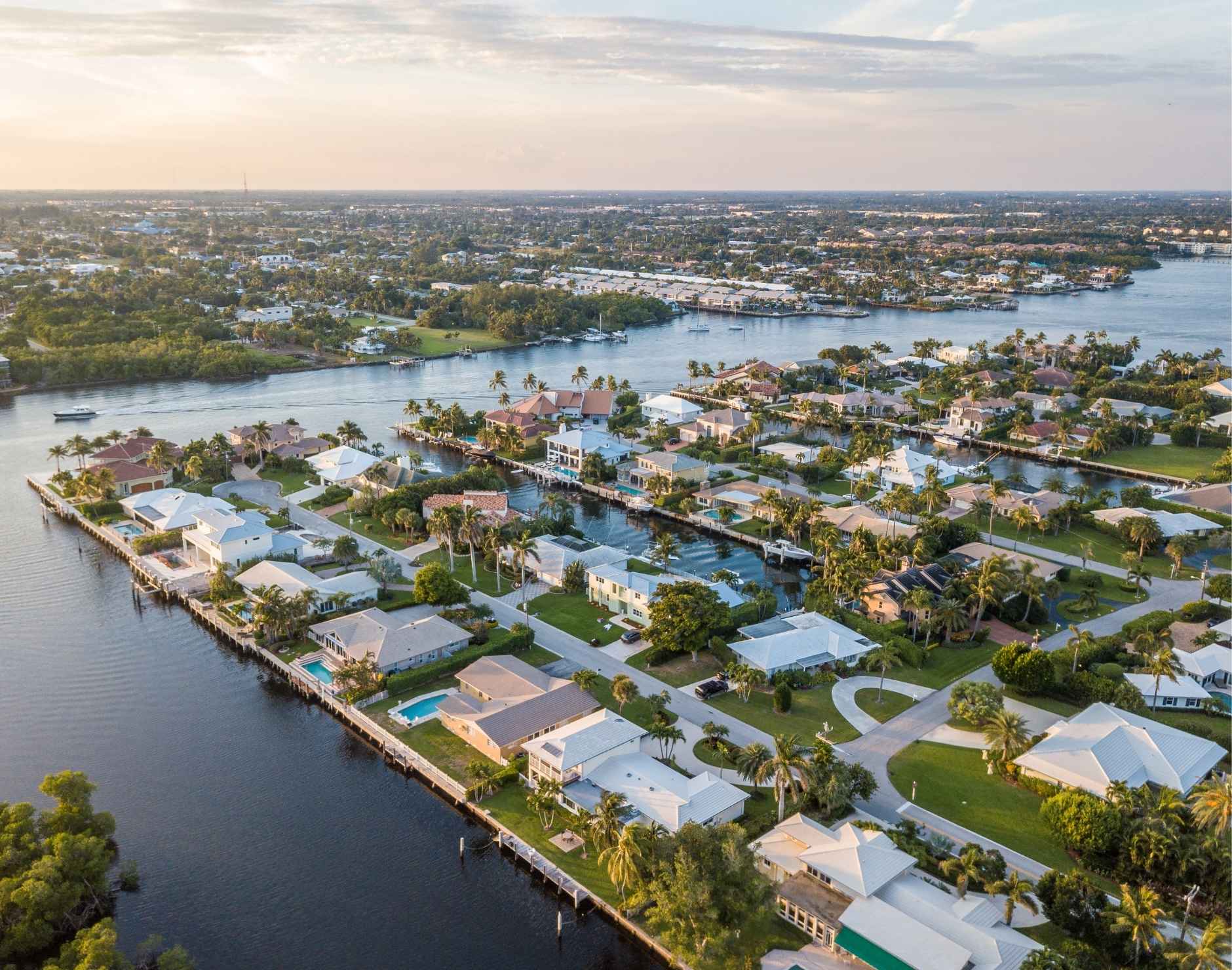
Tequesta’s roofing environment is defined by its water boundaries — three distinct open water bodies that create different exposure conditions for properties along each waterfront. The Intracoastal Waterway running south along the eastern edge of the community, the Loxahatchee River branching inland from the Jupiter Inlet to the north, and the Jupiter Inlet itself where the two meet the Atlantic Ocean collectively create a waterfront geography that makes Tequesta one of the most comprehensively coastal residential communities in the South Florida corridor.
The Intracoastal Waterway along Tequesta’s eastern boundary is classified as an open water body for ASCE 7-22 Exposure Category purposes — its width exceeds the 5,000-foot threshold that triggers Exposure Category D classification for properties within approximately 1,500 feet of its edge. Properties on the Intracoastal side of US-1 in Tequesta — on Riverside Drive, on the canal networks that branch from the Intracoastal, and on the direct waterfront lots along the eastern community boundary — are predominantly Exposure Category D. The prevailing southeast wind carries Atlantic-origin salt aerosol across the Intracoastal’s open water fetch directly onto these properties, amplifying the salt deposition beyond what inland Tequesta properties experience.
The Loxahatchee River creates a distinct waterfront exposure on Tequesta’s northern properties. The river’s width varies along its navigable reach through Tequesta — from the broad open stretch near the Jupiter Inlet to the narrower tidal reaches further upstream — and the ASCE 7-22 Exposure Category classification for Loxahatchee River-facing properties depends on the specific river width at the property’s location. Properties on the lower Loxahatchee near the inlet, where the river is broad and tidal, face exposure conditions comparable to Intracoastal-facing properties. Properties on the upper tidal Loxahatchee, where the river is narrower and partially canopied, face a somewhat reduced exposure that may allow Category C classification depending on the specific site conditions.
Intracoastal-Facing Specification — What the Waterfront Demands
Properties directly on the Intracoastal Waterway in Tequesta — particularly those with east-facing elevations toward the waterway and prevailing southeast wind exposure — require a roofing specification calibrated to the Zone 2 moderate coastal environment defined by their Exposure Category D classification and 1,500-foot open water proximity. This specification tier sits between the most extreme marine-grade requirements of Jupiter Island’s direct oceanfront and the standard HVHZ specification appropriate for inland Tequesta communities.
For metal roofing on Intracoastal Tequesta properties, the correct specification is Kynar 500 PVDF-coated aluminum with 0.032-inch minimum gauge for all panels and flashing components, and aluminum or Type 316 stainless fasteners — the choice between the two depending on the specific elevation’s open water proximity and prevailing wind exposure. Properties with direct southwest-facing Intracoastal exposure — where the prevailing southeast wind creates a direct line of sight from the open water to the roof surface — should specify Type 316 stainless for all fasteners. Properties where the Intracoastal exposure is indirect or partially buffered by vegetation or adjacent structures can use aluminum fasteners with appropriate alloy and anodized finish.
For tile roofing on Intracoastal Tequesta properties, the specification should include a two-fastener-per-tile installation with foam adhesive supplementation in all corner and edge zones per HVHZ requirements, a secondary water barrier of the highest available quality, and polymer-coated concrete tile or terracotta depending on the architectural program. The polymer coating on concrete tile is particularly important for Intracoastal-facing properties where the combination of salt deposition and moderate humidity creates biological growth conditions that are more demanding than inland Tequesta but less extreme than direct oceanfront. A quality polymer coating extends the biological cleaning cycle from the 4-to-7-year interval typical of uncoated concrete to the 7-to-10-year interval achievable with coated product in this exposure zone.
0.032-inch Kynar-coated aluminum minimum for all metal components Standard 0.019-inch or 0.027-inch aluminum is inadequate for Intracoastal Tequesta exposure. The heavier gauge and PVDF coating provide the corrosion reserve and UV resistance appropriate to this environment.
Replace all original galvanized flashing at every re-roofing project Pre-2000 galvanized flashing on Intracoastal Tequesta properties has exceeded its coastal service life. Comprehensive flashing replacement — not selective repair — is the correct scope for every Intracoastal re-roofing project.
Polymer-coated concrete tile extends biological cleaning interval The Intracoastal salt-humidity combination creates accelerated biological growth on uncoated concrete tile. Factory-applied polymer coating extends the cleaning cycle by 3 to 5 years — a meaningful maintenance reduction over a 25-year roof life.
SWB is mandatory — do not accept felt-only underlayment on any re-roof Florida Building Code requires SWB on all tile re-roofing projects that trigger code compliance. Any contractor proposing felt-only underlayment on a Tequesta re-roof is proposing a non-compliant installation.
Loxahatchee River Corridor — Tequesta’s Overlooked Exposure Zone
The Loxahatchee River corridor through Tequesta is one of the most aesthetically distinctive residential environments in northern Palm Beach County — a tidal river flanked by preserved natural vegetation, with estate properties that blend luxury program and natural setting in a way that the Intracoastal’s more developed corridor cannot replicate. It is also one of the most misunderstood roofing exposure environments in the market, because the river’s natural character gives properties along it an appearance of sheltered privacy that can lead homeowners and their contractors to underestimate the actual salt exposure conditions.
The lower Loxahatchee River — from the Jupiter Inlet upstream to approximately the Boy Scout camp — is a broad, tidally influenced waterway that functions as an open water body for ASCE 7-22 Exposure Category purposes at the width it carries near the inlet. Properties on the lower Loxahatchee within approximately 1,500 feet of the river’s open stretch are classified as Exposure Category D and face salt aerosol concentrations comparable to Intracoastal waterfront properties. The river’s connection to the Jupiter Inlet — which opens directly to the Atlantic — means that strong onshore winds drive salt-laden air from the ocean through the inlet and up the river, creating periodic high-concentration salt exposure events that affect properties well upstream of the inlet itself.
Properties on the upper tidal Loxahatchee, where the river narrows and the natural vegetation provides a degree of wind and salt aerosol attenuation, may qualify for Exposure Category C classification — but this determination requires site-specific evaluation rather than assumption based on the river address alone. A contractor who classifies all Loxahatchee River properties as Category C without a site-specific evaluation is applying an incorrect specification to at least the lower-river properties, which face Category D conditions that a Category C specification will underserve. Conversely, a contractor who classifies all Loxahatchee properties as Category D is potentially over-specifying the upper-river properties where a correctly evaluated Category C classification would allow a more cost-effective material selection.
Why Luxe Roofing Is Tequesta’s Roofing Authority
Luxe Roofing is not a regional contractor that serves Tequesta as one market among many — we are a Tequesta-based contractor whose entire business has been built on serving the specific roofing needs of this community and its immediate neighbors in Hobe Sound, Jupiter Island, and Jupiter Inlet Colony. That distinction matters in practical ways that affect every aspect of a roofing project — from permit submission to material delivery to post-project wind mitigation documentation.
Our permit relationship with the Palm Beach County Building Division reflects over two decades of permitted projects in this jurisdiction. We know the inspectors, we understand their expectations for HVHZ documentation, and we have structured our project management process around the specific sequencing — deck inspection before underlayment, dry-in before tile, wind mitigation inspection before final closeout — that Palm Beach County’s HVHZ permit process requires. Projects that go smoothly through permit and inspection do so because the contractor executing them has done it correctly enough times in the same jurisdiction to have eliminated the surprises that delay less experienced contractors’ projects.
Our material relationships in the Tequesta market give our clients access to the specific products — HVHZ-listed tile in the colors and profiles that complement Tequesta’s architectural character, marine-grade aluminum from distributors who stock the correct alloy and gauge for coastal application, and self-adhering SWB products from manufacturers whose HVHZ FPA listings are current and whose installation requirements our crews have executed on hundreds of projects — without the lead times and substitution risks that contractors who do not regularly work in this market encounter. When a project specification calls for a specific HVHZ-listed tile in a specific color, we know which distributors carry it, what the lead time is, and what the HVHZ-compliant alternative is if the specified product is unavailable.
Based in Tequesta — not a regional contractor serving this market from outside Our office, our crews, and our material suppliers are all in and around Tequesta. We do not mobilize from a distant base for Tequesta projects — this is our home market and our primary focus.
22+ years of Palm Beach County HVHZ permit history Established inspector relationships, proven permit sequencing, and hundreds of closed permits in the Tequesta and northern Palm Beach County corridor. Our permit track record is verifiable through Palm Beach County’s online permit portal.
Site-specific exposure zone assessment on every project We do not apply a generic coastal specification to every Tequesta property. We evaluate your specific waterway exposure, classify your property’s ASCE 7-22 Exposure Category, and calibrate the material specification to your actual environment.
Complete documentation package delivered at project completion Permit number, FPA numbers for all components, dry-in and final inspection certificates, and wind mitigation inspection coordination — all assembled and provided to you at project completion as your permanent roofing record.


